In just four days at the end of October, the tragic reality of Greater Manchester’s rising road violence epidemic was laid bare. A man walking on the A6 in Stockport died after being hit by a Bee Network bus, a man in his 80s on a bike was left with life-threatening injuries after being struck by another Bee Network bus on Deansgate, and a 19-year-old man was critically injured following a collision on the Mancunian Way. All in the same week that the man who murdered headteacher Michael Mullins as he cycled home was jailed for life. These are ordinary people making everyday journeys, yet their lives and families have been unnecessarily devastated beyond comprehension.
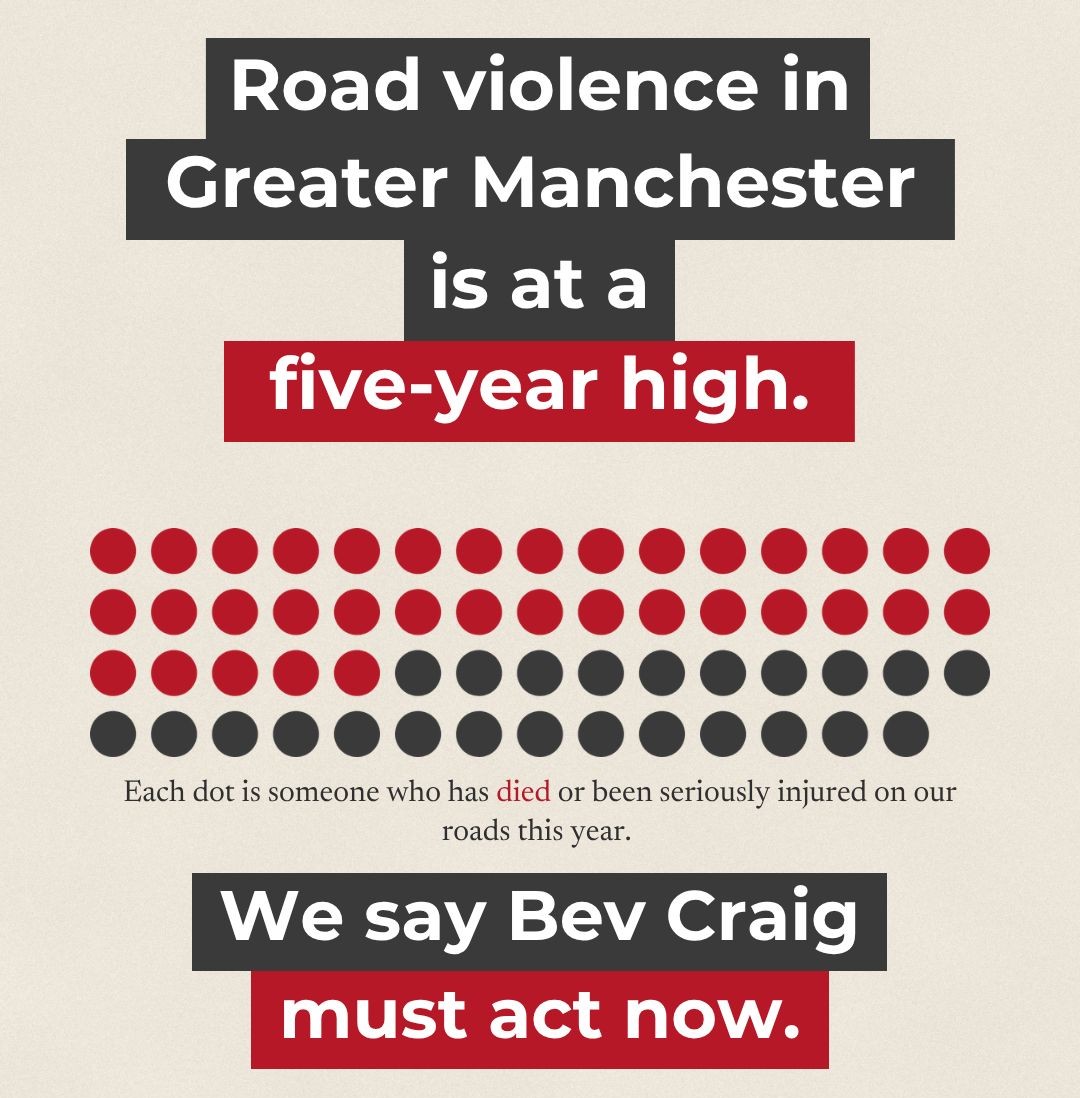
Greater Manchester’s Vision Zero strategy promises to eliminate deaths and life-changing injuries on our roads by 2040, with a crucial interim target to halve them by 2030. But the region is heading in the wrong direction. Rather than falling, the toll of road violence is rising. TfGM’s own figures, reported to the Bee Network Committee in January, show 461 people were killed or left with life-changing injuries on our roads in 2024. That represents an increase of nearly a third from the previous year, pushing casualties even higher than the 2022 baseline used for the strategy. The Department for Transport’s figures, published in July, tell the same story: 1,043 people were killed or seriously injured on Greater Manchester’s roads in 2025, the most in any of the last five years and 31% more than in 2023.
And the harm is not shared evenly. Manchester City Council’s own analysis shows that people walking, cycling and motorcycling make 41% of trips in the city but account for 67% of those killed or seriously injured, mostly in collisions with motor vehicles. Of the older people killed or seriously injured in Manchester, 72% were on foot. Meanwhile, vehicles are getting bigger. Research by Transport & Environment found that the average new car bonnet is rising by half a centimetre every year, while a bonnet just 10cm higher increases the risk of death for people walking and cycling by 27%. The pattern is already visible here. Between 2021 and 2025, the number of people killed or seriously injured while cycling in Greater Manchester rose by 61%, from 127 to 204. For people walking it rose by 29%, from 242 to 311. For people in cars it rose by 8%. People on foot and on bikes now make up almost half of everyone killed or seriously injured on our roads.
Thankfully, one borough is taking action. On 3 November, Manchester City Council published a draft Vision Zero Strategy and Action Plan. It setting clear targets: half as many deaths and serious injuries by 2030, 70% fewer by 2035, and none by 2040. The plan is grounded in evidence. Speed was a factor in 70% of collisions in the city between 2019 and 2023, while wards that introduced 20mph limits early have seen pedestrian casualties fall by 38%. The strategy makes 20mph the default on residential streets, prioritises safer junctions and crossings, and commits to reviewing every fatal and serious collision. It goes to the council’s Executive on 11 November and then out to public consultation. But Manchester is only one of ten boroughs- road danger does not stop at Princess Parkway or the Stockport border, and now the rest of Greater Manchester needs to deliver too.
but responsibility for Bee Network bus contracts ultimately rests with the Mayor and TfGM. These should be the safest buses in the country, with drivers trained to the highest standards. In January, the Bee Network Safety Plan presented to the Bee Network Committee promised a new Greater Manchester Bus Safety Standard, supported by enhanced driver training and annual audits of every operator. Yet neither the standard nor any audit results appear to have been published. So who is checking that Bee Network drivers are properly trained to protect people walking and cycling? If the brand is the Mayor’s and the contracts are the Mayor’s, the standard has to be the Mayor’s too.
Enforcement is also moving in the wrong direction. Greater Manchester Police detected 146,339 speeding offences in 2025, down from 214,852 the year before. That is almost a third fewer, in the year road danger reached a five-year high. The number of drivers sent to court has fallen every year since 2023. Meanwhile, the public submitted more than 6,000 dashcam and helmet camera clips through Operation Snap in 2024, yet GMP says it does not record what action is taken in response.
To expose the true scale of this crisis, Walk Ride GM has today launched a new dedicated tracker, Road Violence GM (roadviolencegm.org.uk). The site brings casualty figures out of committee appendices and into the public eye, mapping the latest data and tracking every death and serious injury day-by-day so the public can see exactly what is happening on our streets.
What Walk Ride GM is asking for
- Convene an emergency road danger summit with the ten councils, police, TfGM, and bus operators before Christmas.
- The other nine Greater Manchester councils to deliver on Vision Zero as Manchester is, with local plans that match Manchester’s targets (half by 2030, 70% fewer by 2035, none by 2040), each out for consultation within twelve months.
- The Mayor and GMCA to add a 2035 target and speed commitments to the Greater Manchester strategy, fund it, and report every borough’s progress each year.
- The Bus Safety Standard GMCA promised in January, published and written into every bus contract, with driver training on driving around people walking and cycling, and annual audits of every operator.
- Parking charges and permits that rise with the size and weight of the vehicle in every borough, as Cardiff has proposed, so the biggest cars pay more for the space they take up.
- Greater Manchester Police to publish every quarter the outcomes of Operation Snap footage, and the Mayor to set a target for speed enforcement in every borough and report against it.