What does a good public bike hire scheme look like?
Walk Ride GM exists to help make walking, wheeling and cycling the easiest and best choice for most people’s everyday journeys. A vital piece of that puzzle is a shared bike hire scheme that offers widespread coverage, reliable bikes, and convenient access for as many people as possible across the whole region.
We do not believe the current Bee Bike model – managed by TfGM, operated by Beryl, and sponsored by Starling Bank – is meeting these basic criteria.
What is the issue with the current scheme?
- Limited coverage and few docking stations: The current scheme is absent from large parts of Greater Manchester. Because bikes must be returned to fixed physical docking stations, and there are far too few stations, the scheme is impractical for most everyday trips.
- Fleet reliability and lock failures: A large proportion of the fleet consists of standard bikes rather than e-bikes. The digital and physical locks are notoriously unreliable, leading to frequent app errors, unlock failures, and users being incorrectly fined. We carried out a survey last June, with 74% of 236 of respondents highlighting locking and unlocking the bikes as an issue
- Lack of financial transparency: While Beryl operates the bikes, the scheme is owned and subsidised by TfGM. Despite corporate sponsorship from Starling Bank, true public costs remain hidden, as detailed financial performance and ride-level breakdown metrics are not published.
- Lagging behind other UK cities: Other major UK city-regions that previously operated similar subsidised, docked models have ended those contracts. By shifting to operator-funded, zero-subsidy models, they have seen massive expansions in fleet size, geographic coverage, and overall ridership.
Why does this matter?
An effective shared bike hire scheme dramatically expands access to cycling. When a significant proportion of the fleet is electric, it enables people to travel further, negotiate hills, and ride in everyday clothing.
The flexibility of picking up and dropping off bikes closer to where people actually need them offers true multi-modal journey options, such as cycling one way and taking public transport home if conditions change. Evidence shows that high-density, flexible schemes significantly expand the catchment area of bus, tram, and train stations. Ultimately, a well-run shared bike and e-scooter network reduces private car reliance, eases traffic congestion, cuts carbon emissions, and improves public health and air quality.
According to analysis by transport consultancy Steer, a high-density bike hire scheme in Greater Manchester could unlock up to £28 million per year in health, environmental, and economic benefits.
What do we want to see?
We want an effective, well-maintained, and well-regulated bike hire scheme with better fleet density, a higher proportion of e-bikes, and comprehensive coverage across Greater Manchester. We care about performance and availability, not who owns or operates the bikes. Our position is not that any particular provider should replace Beryl; it is simply that the current state of affairs is not good enough.
Is dockless the answer?
More docking stations require heavy investment, which could slow any expansion down.
A dockless scheme is more flexible, but requires a more active fleet management to ensure that bikes are not abandoned.
In London, where there is already a large proportion of shared bikes in dockless schemes, the bikes are often in the news for being a nuisance. Whilst we fully acknowledge that badly parked bikes are a serious accessibility issue, we believe solutions are available and that councils can work with providers to ensure these are implemented. On-road car parking spaces should become designated parking areas in order to ensure bikes do not block pavements.
What are we asking for?
We are not stating our preference, just that we advocate for a well-regulated scheme that learns lessons from elsewhere and protects our pavements through a combination of measures such as monitoring technology and operator fines.
We would like to see an options appraisal for the successor to the current cycle hire contract, with an operator-funded dockless e-bike and e-scooter concession as the base case: sized to TfGM’s own ambition of 8,000 hire vehicles, phased by borough and at no public subsidy. Bee Network branding and ticketing should be an ambition for the concession, to be aligned as the technology allows, not a condition of it.
The numbers
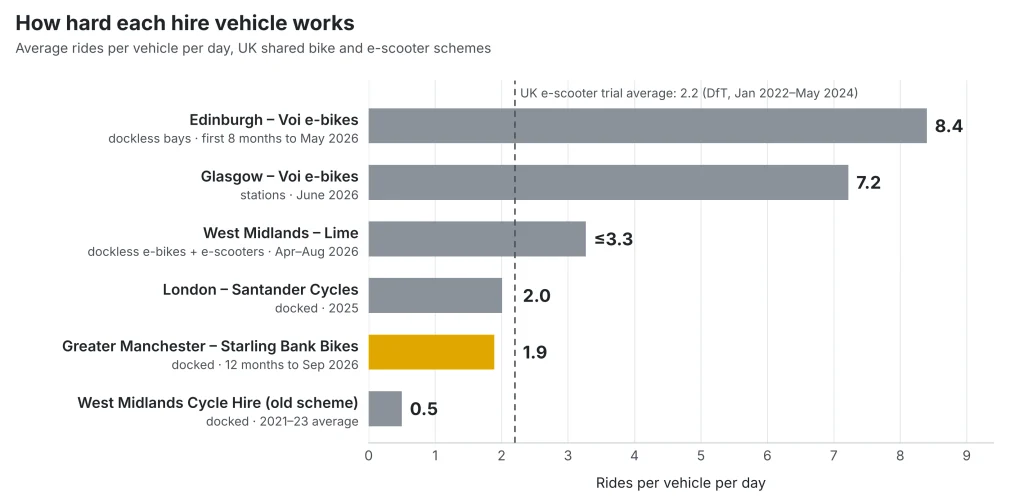
1.9 vs 7.2. Each available Starling Bank Bike is hired about 1.9 times a day. Voi’s e-bikes in Glasgow were hired 7.2 times a day in June 2026, and Edinburgh’s 8.4 times a day.
723 bikes. That’s how many hire bikes TfGM had available across Greater Manchester in July 2026, rising to 897 in September. TfGM blames supply-chain problems, vandalism and repairs. Its own ambition is 8,000.
£1.4 million to £0. The West Midlands paid about £1.4 million a year to run its old docked cycle hire scheme. Its new operator-funded scheme costs taxpayers nothing.
One million rides in five months. Lime’s West Midlands scheme passed one million e-bike and e-scooter rides between April and early September 2026, about 6,500 a day. Greater Manchester’s scheme took 619,000 rides in a whole year.
Sources and notes
Rides per vehicle per day = average daily rides ÷ number of vehicles.
- Edinburgh, Voi e-bikes: 8.4. Figure stated by the City of Edinburgh Council’s Transport Convener for the scheme’s first eight months. Scottish Business News
- Glasgow, Voi e-bikes: 7.2. 216,574 hires in June 2026 ÷ 30 days ÷ about 1,000 bikes. Edinburgh Evening News / The Scotsman; fleet size: University of Glasgow
- West Midlands, Lime: up to 3.3. One million e-bike and e-scooter rides from 1 April to 31 August 2026 (about 6,500 a day) ÷ “more than 2,000” vehicles at launch. Lime hasn’t published its fleet size, and the fleet grew when the scheme expanded in June, so the true figure is probably lower. TheBusinessDesk; WMCA
- London, Santander Cycles: 2.0. 8.8 million hires in 2025 ÷ 365 ÷ about 12,000 bikes. TfL, Travel in London 2025
- Greater Manchester, Starling Bank Bikes: 1.9. 619,000 rides in the 12 months to September 2026 ÷ 365 ÷ 897 bikes available in September 2026. Fewer bikes were available earlier in the year (723 in July), so the year-round rate per available bike was a little higher. Bee Network Performance Report, Bee Network Committee, 29 October 2026
- West Midlands Cycle Hire (old scheme): 0.5. Average of 750 rides a day in its first two years (2021–23) ÷ 1,500 bikes. WMCA; BirminghamWorld
- UK e-scooter trial average: 2.2. Department for Transport, average across all trial areas, January 2022 to May 2024. DfT monitoring data report
The time periods differ between schemes, as shown on each label. The Glasgow figure is for a single summer month. The others are averages over longer periods.