
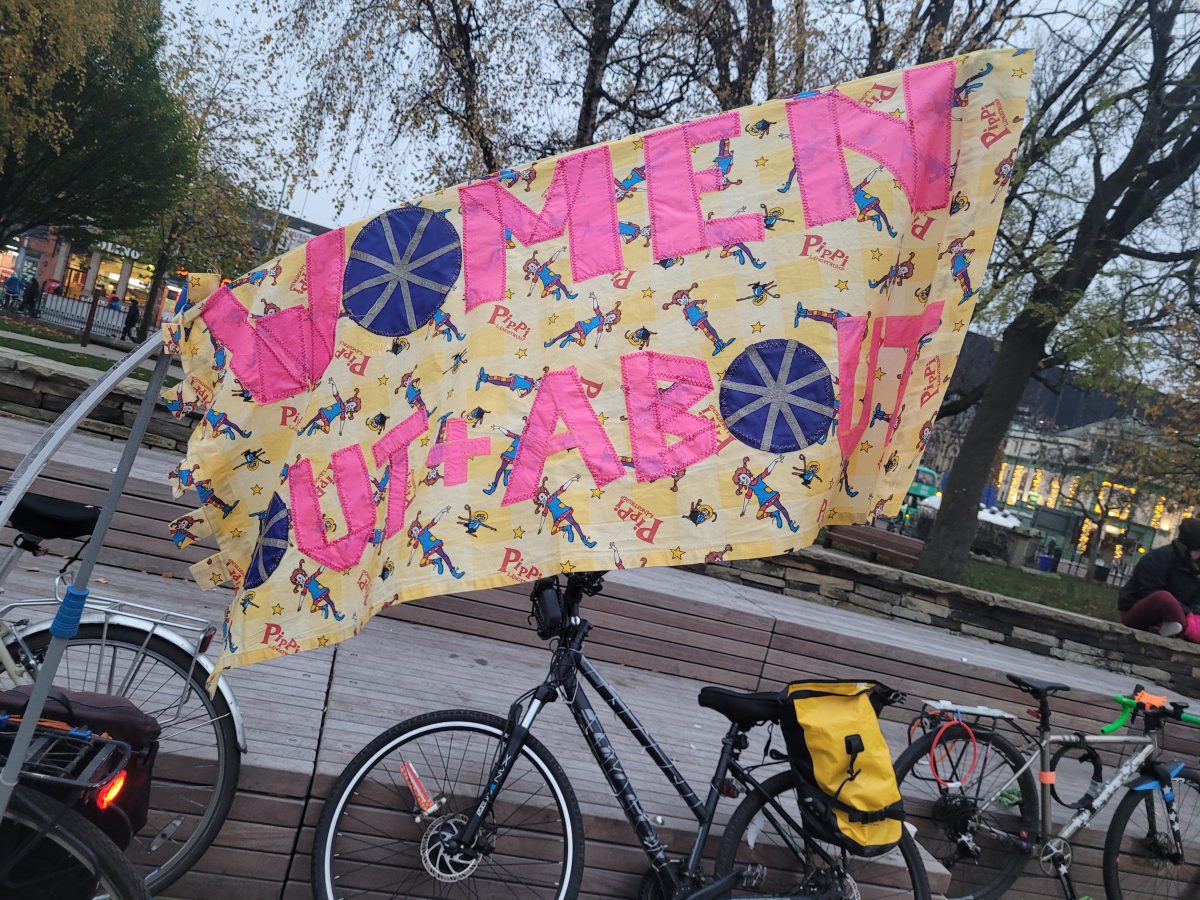
Currently, many of Greater Manchester’s designated walking, wheeling and cycling routes are off-road, through parks or diverted along dark, quiet streets with limited passive surveillance.
These routes are often indirect, causing inconvenience for people making sustainable travel choices, increasing the distance and time to get from A to B, compared to using a direct route. And if you factor in the fact that women are more likely to ‘trip-chain’ – which involves combining multiple trips in a single journey, it’s more like A to B to C to A to D to A.
And women often feel unsafe. A recent study in Greater Manchester found 68% of women compared to 20% of men reported feeling unsafe going out alone after dark. Women are more likely to cite concerns about road danger and the lack of safe cycling infrastructure as a reason not to cycle.
In 2021, the Greater Manchester Mayor Andy Burnham launched the #IsThisOK? campaign to tackle gender-based violence. This followed on from the GM region’s 10-year Gender-Based Violence Strategy with its 2024-26 Delivery Plan including: “Helping people feel safe across our transport network by challenging gender-based violence and exploring safe spaces.”
Reliance on an off-road network for active travel becomes an important equality and personal safety issue. We believe that the allocation of investment should always be in safe active travel routes that are direct, well-lit, protected and well-used rather than in quiet off-road alternatives. An example of this was our objection to the use of scarce active travel funding for a scheme to resurface and widen the Fallowfield Loop route.
Right to the Streets
There are a number of initiatives happening across Greater Manchester which aim to tackle this issue.
GM Moving set up the Right to the Streets scheme as a means to explore, alongside partners in Trafford, how to make our streets and public spaces more welcoming for women and girls.
Reclaim the Night is an annual march after dark in Autumn with a message calling for an end of sexual violence and to ensure safety and autonomy for all women and marginalised genders in Manchester.
There is an annual group cycle ride named Lights Up that aims to raise awareness of the issues faced by women while cycling – particularly during darker hours and across the winter months. The Manchester Bicycle Mayor Belinda Everett said:
“Especially in Greater Manchester right now, the number of women cyclists is still really, really low. So, having an event like this gives them an opportunity to all come together and ride together.”
Solutions nationally have been patchy. One example includes Surrey Police’s Jog On campaign to tackle harassment of female joggers. The scheme is deploying non-uniformed female Surrey Police officers jogging in key locations, with instances of catcalling and sexually suggestive comments being dealt with by support crews.
Studies from elsewhere
The Unsafe in the City: The everyday experiences of girls and young women report shows that 58% of girls in major cities worldwide feel unsafe walking in their communities, and that disabled women, including wheelchair users, often face additional challenges and higher levels of fear when navigating public spaces.
In the UK, the 2023 National Travel Attitudes Survey showed that 38% of women and 23% of men feel unsafe during the first and last mile of their journey. When asked about safety precautions while walking or cycling, 27% of women reported opting for private transport (e.g. car, motorcycle, van), and 25% preferred using a taxi instead.
In 2023, London Cycling Campaign (LCC) commissioned a survey to find out What Stops Women Cycling in London?
It states:
“Based on more than 1,000 responses, the survey results show with real clarity some of the key factors that put women off cycling in London – including a shocking level of abuse and aggression from drivers, and a lack of safe cycle routes to use all year round. Too many women have to choose between routes that they feel put them in danger or at risk of conflict, either on busy hostile roads or quiet unlit routes. Most say that they don’t have a local cycle network that meets their needs, especially when cycling with children.”
Nearly all respondents indicated that half or more of their journeys are local (less than three miles from home). However, 29% avoid these shorter trips due to unsafe routes, demonstrating the need for improved infrastructure to make cycling a viable option.
This is echoed in a survey conducted by the world’s largest e-bike provider, Lime, which also lists anti-social behaviour (36%) and fear of harassment from other road users (34%) as key barriers for female cyclists.
Female riders responded that they are less willing than their male counterparts to walk long distances alone at night to access parking for cycle hire schemes – nearly two-thirds (63%) of female riders reported that they would only be comfortable walking a maximum of three minutes between a parking location and their destination. This is nearly double the proportion of male riders – only 35% of men stated that three minutes was their maximum walking time.
The research found that 100% of female survey respondents want improvements aimed at personal safety. Adopting a safe system approach as advocated by Vision Zero enables designers to consider how these various factors can and should work together to create a safe solution.
The LCC and Lime surveys reiterate the results of numerous other studies – that the proportion of female users increases where protected lanes are installed. In the Netherlands (and other countries where protected lanes have been installed along main, direct routes) women’s cycling mode share is higher than men’s.
Call to Action
At Walk Ride GM, we’re demanding safe active travel for women and girls in Greater Manchester.
If you would like to join Walk Ride GM’s working group to campaign on this issue in Greater Manchester, please contact us at hello@walkridegm.org.uk.